
Sleep Is Shaped All Day Long: Why Outdoor Play Matters More Than You'd Think
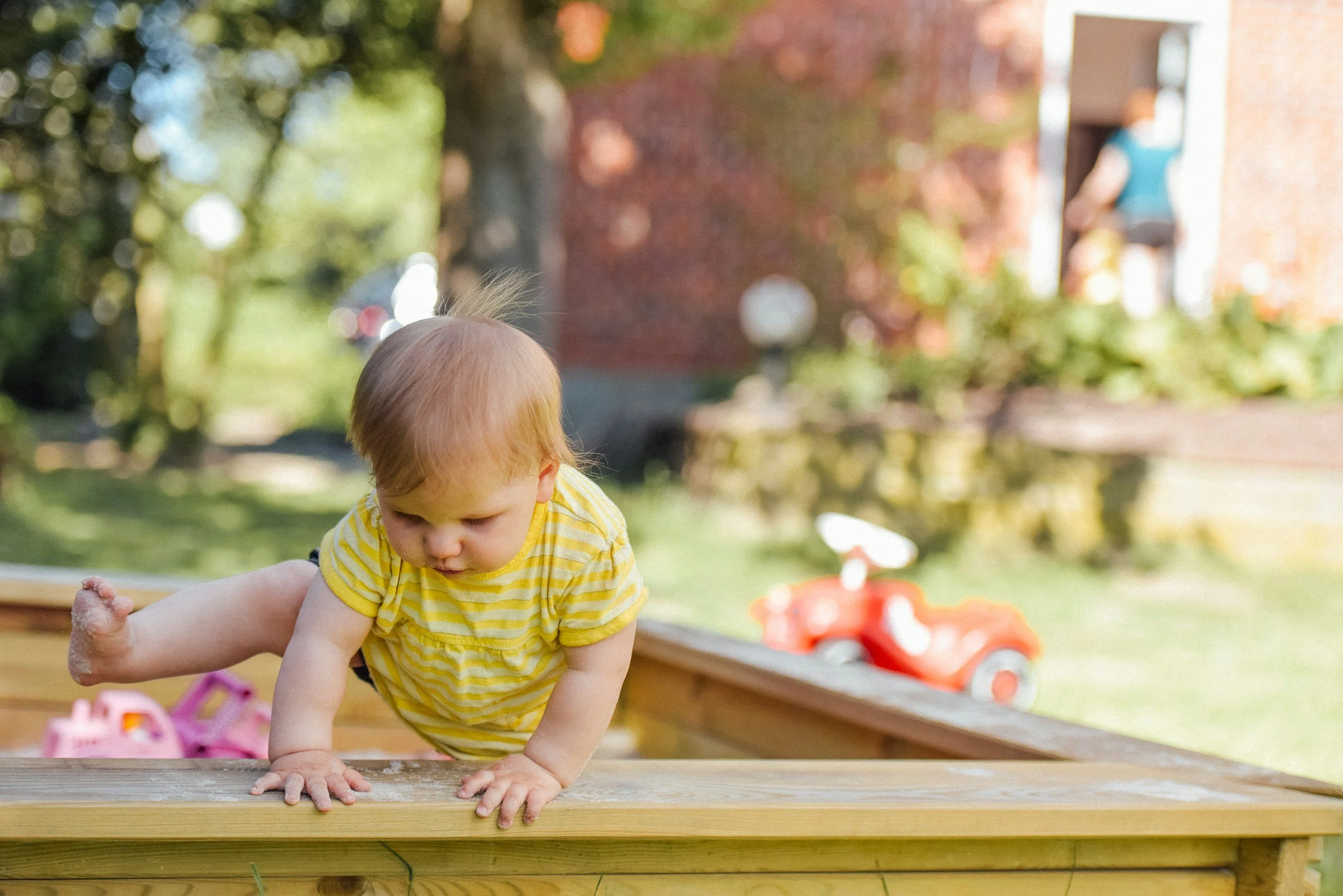
Playing Helps Sleep
Picture two versions of the same toddler. In one, he has spent the afternoon at the playground, running, climbing, chasing pigeons he will never catch. In the other, he has spent the same afternoon bouncing between the living room and a screen, cooped up on a rainy day. Same bedtime, same book, same lullaby. Two completely different nights of sleep.
Here is why.
We tend to think of sleep as something that starts the moment the lights go off. In reality, sleep is being shaped hours before bedtime ever begins. Movement, sunlight exposure, opportunities for regulation, and even small moments of connection throughout the day all influence how a child's body settles at night. That is one of the reasons outdoor play can be so supportive for sleep, long before anyone is brushing teeth or reading a bedtime story.
What I Saw With Baby O
I spend most of my working hours thinking about the thirty minutes before lights-out. But it was my own two-year-old who reminded me recently just how much the other twenty-three and a half hours matter, too.
I recently had an experience where Baby O had limited outdoor play. He became more restless at night, took longer to fall asleep, and started seeking out movement and silliness right around the time he would normally be settling into the evening, because we had kept things indoors that day. The apartment and structured classes were not meeting the movement and engagement needs of my two-year-old. So I had to pivot and reconfigure how I structure our days.
It was a good reminder that sleep struggles at 7pm often have very little to do with what is happening at 7pm.
Why Movement and Sunlight Matter for Sleep
Running, climbing, exploring, and simply being outside helps support nervous system regulation, while also giving the body important input for the circadian rhythm, the internal clock that helps the brain recognize when it is time to be awake and when it is time to rest.
A 2020 systematic review published in Sleep Medicine Reviews looked specifically at movement behaviours and sleep in children under five. In the small number of studies that examined outdoor play directly, toddlers and preschoolers who spent more time playing outside tended to have earlier bedtimes, shorter time to fall asleep, and fewer night wakings (Janssen et al., 2020). The researchers were careful to note that this evidence is still early. Only a couple of studies looked at outdoor play specifically, and the overall quality of evidence in this area was rated very low, so this is a promising early signal rather than a settled fact. The review also pointed to separate research suggesting that in infants, natural light exposure, especially in the afternoon, may be associated with improved nighttime sleep, possibly through its role in regulating melatonin and circadian rhythm (Janssen et al., 2020).
The review authors also proposed some possible reasons why movement might help sleep, drawing on research conducted mostly in adults. Physical activity raises body temperature, and the cooling-down process afterward may help cue the body toward sleep onset. Activity may also help reduce physiological arousal that can otherwise get in the way of settling down (Janssen et al., 2020). These mechanisms have not been directly tested in young children, but many parents will recognize the pattern from watching a toddler go from bouncing off the walls to completely wiped out after an afternoon at the park.
More Than the Science
Beyond the research, outdoor play offers something many kids deeply need after long days full of expectations and stimulation: space to decompress and just be.
Unstructured time outside does not come with the same demands as a structured class or an indoor activity. There is room to move at their own pace, follow their own curiosity, and let their nervous system reset before the day winds down.
If your child has been more restless at bedtime lately, it might be worth looking at the whole day rather than just the thirty minutes before lights-out. Sometimes the most effective sleep support does not happen in the bedroom at all.
What kind of outdoor activities has your child naturally gravitated toward lately? If Sleep Has Felt Challenging Lately
You do not have to figure this out alone. We offer:
Virtual sleep consultations for families across British Columbia
Hybrid support from Vancouver and the Fraser Valley to Victoria and Langford
Support for families across Canada and beyond
Source:
Janssen, X., Martin, A., Hughes, A.R., Hill, C.M., Kotronoulas, G., & Hesketh, K.R. (2020). Associations of screen time, sedentary time and physical activity with sleep in under 5s: A systematic review and meta-analysis. Sleep Medicine Reviews, 49, 101226. https://doi.org/10.1016/j.smrv.2019.101226